What Is an AIOS? Your Complete Guide to the AI Operating System
An AI Operating System connects your data, AI tools and workflows into one intelligent layer. Learn what an AIOS is, how it works and why it matters.
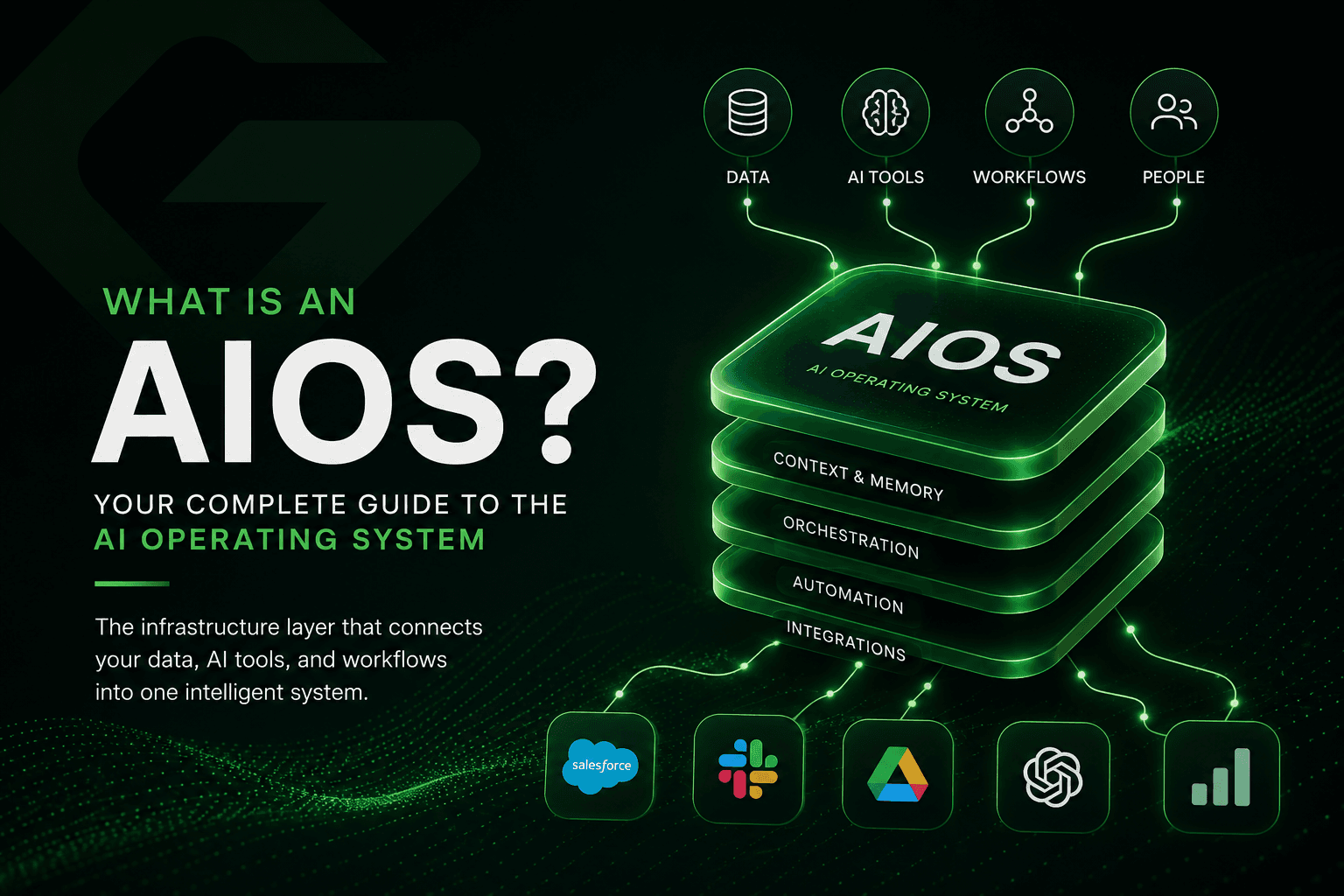
Most businesses are using AI wrong. Not because they don’t see the upside, but because the pace of change makes it almost impossible for busy leaders to choose the right architecture in real time. The result is fragmentation: a pile of disconnected tools instead of an actual system.
Teams across the country are embracing LLMs and AI. The problem is they’re using them like islands. Chatbots handle customer enquiries. LLMs write content. Automated follow-ups go out. Internal workflows do their own thing. Nothing talks to anything else. Every tool is an island. Every answer is different. Every conversation starts from zero.
In most businesses we work with there is an understanding that AI has utility, but it is often a small group of early adopters pushing change from the bottom up. That leads to fragmentation, and while the C-suite can point to it and say the company is AI-first, that’s not an AI strategy. That’s an AI reaction.
AI transformation in the real world is a story of three groups: the people at the coalface adopting AI, their colleagues who aren’t, and senior leadership which sees the long-term value but doesn’t yet understand the architecture. The middle layer is missing.
There’s a name for that middle layer, and it’s simpler than you might think.
What Is an AIOS? The Kernel of the AI Operating System Concept
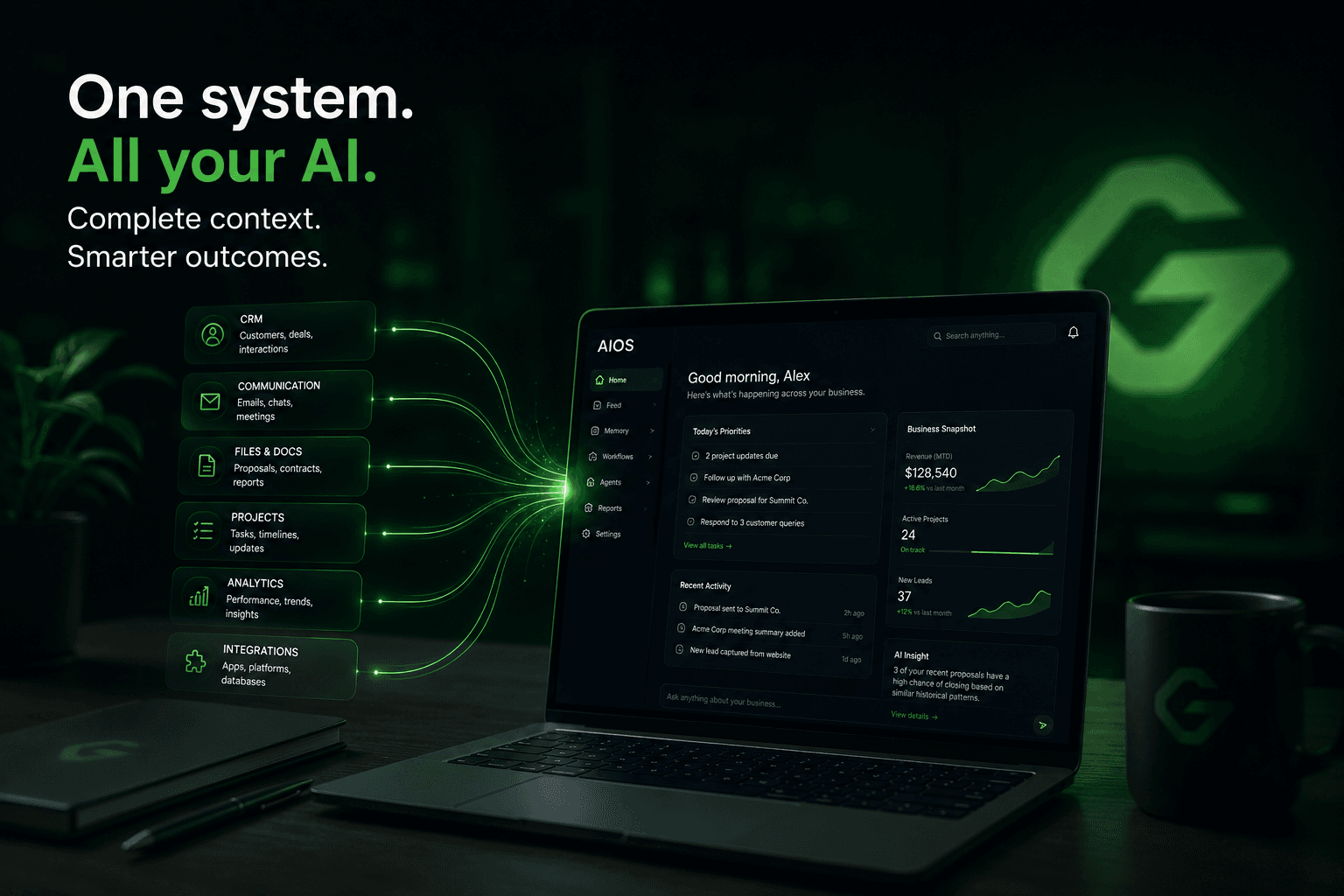
An AI Operating System (AIOS) is the AI infrastructure layer that connects and enhances your data, your AI tools and your business workflows into one coherent system. Done well, it’s the difference between AI investment that becomes a black hole and AI investment that compounds into real capacity and efficiency.
Think of it like your computer’s traditional OS. macOS or Windows doesn’t do the work; Photoshop does the design, Excel does the spreadsheets, Chrome does the browsing. The operating system connects them, gives them access to your files, your network, your hardware. Without it, each app is flying blind.
An AIOS does exactly that for your AI stack.
It gives every AI tool and intelligent agent access to the same knowledge, the same context and the same understanding of your business. When one system learns something, every other system knows it too. When a decision is made, it’s remembered. When a prospect becomes a customer, the whole organisation updates, with the right multi-agent design and a unified interface.
What an AIOS Actually Does
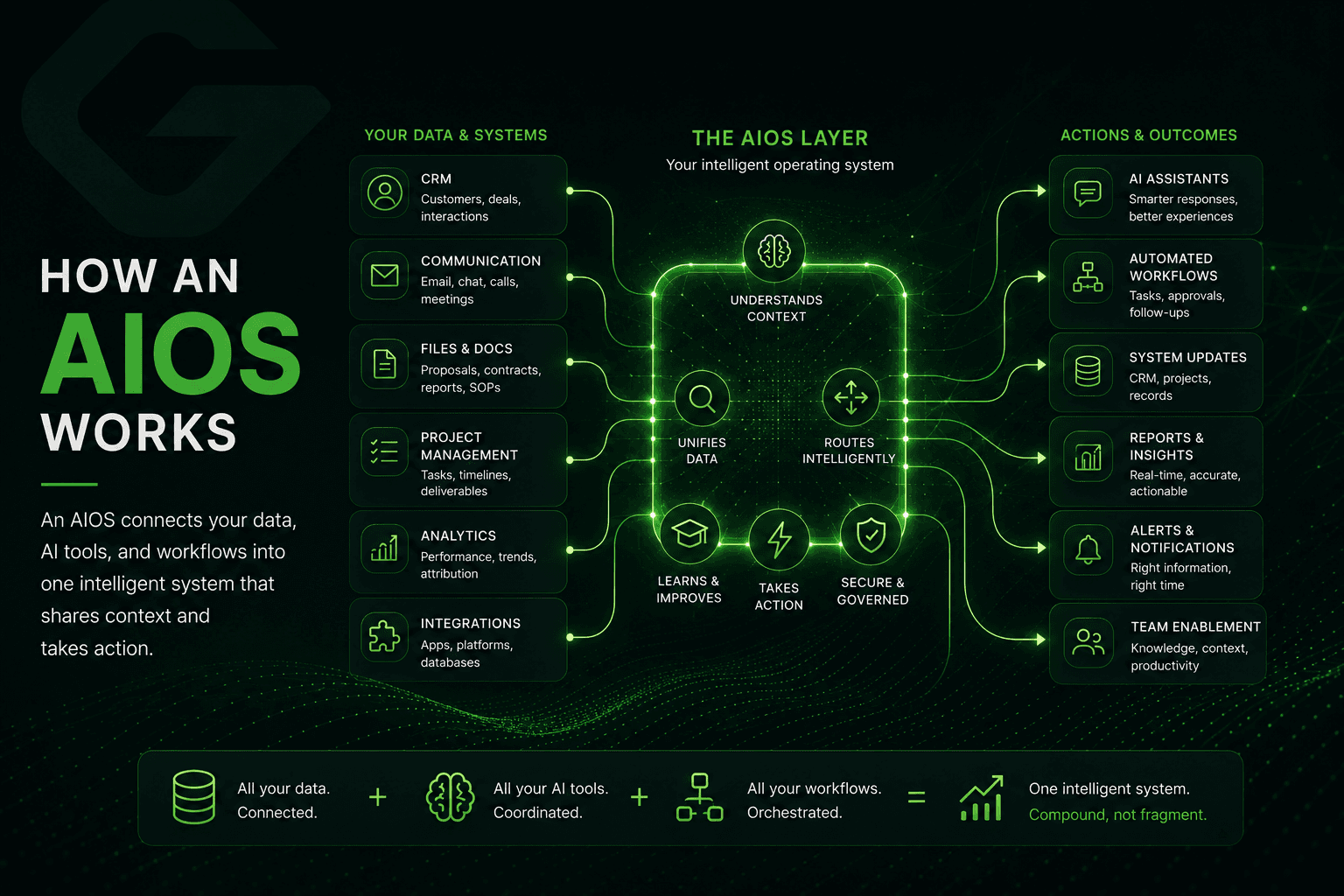
An AIOS handles five things that point tools can only dream of.
1. It remembers everything
Your CRM holds customer data. Your email holds conversations. Your project tool holds decisions. Your team knows context they’ve never written down. An AIOS pulls all of that into one searchable memory layer that any AI can draw from. This is what turns existing AI investment from an institutional bottleneck into critical infrastructure.
2. It routes intelligently
A customer asks a pricing question. Your AIOS doesn’t generate a generic answer; it checks recent deals, your pricing policy and that customer’s specific context, then responds with a reply grounded in your actual business data. Then it decides whether to handle it, escalate it or create a follow-up task.
3. It connects your tools
Your AI doesn’t just write text. It updates the CRM, logs the interaction, triggers follow-ups, schedules appointments, generates reports and notifies the right person at the right time. An AIOS is the connective tissue between intelligence and action.
4. It learns and improves
Every interaction, outcome and decision feeds back into the system. The AIOS gets smarter over time, understanding which leads convert, which responses work and which processes need attention. You’re not running the same system next month that you are today.
5. It scales without adding overhead
More work comes in? The system handles it. New team members join? They inherit the full knowledge base instantly. New tools get adopted? They plug into the existing infrastructure.
Why Businesses Need an AIOS Now
Here’s the truth: individual AI tools will keep getting cheaper and better. That isn’t your competitive advantage any more. The moat is how you wire them into your business.
An AIOS solves the problems that are quietly costing you money.
Context loss
Your team asks ChatGPT to analyse a client’s data. It doesn’t know about the meeting your account manager had last week. Your marketing team writes copy without context on what’s actually converting. Every tool works from its own slice of reality. An AIOS gives them the full picture.
Redundant work
Three different people ask AI to research the same competitor. Three separate outputs. Nobody checks if it’s already been done. An AIOS surfaces existing knowledge before new work starts.
Scaling without breaking
Most growing businesses hit a wall where adding more AI tools creates more complexity, not more capability. More passwords, more subscriptions, more places for knowledge to get trapped. An AIOS scales your AI automation and intelligence without scaling your admin overhead.
Inconsistent results
Without shared context, the same question gets different answers depending on who asks and which tool they use. An AIOS provides a single source of truth that every conversation draws from.
What AIOS Architecture Looks Like in the Real World
Theory aside, here’s what running an AIOS actually looks like for the kind of business we work with.
Monday morning. Your AIOS has scanned your project tool, flagged two deliverables at risk this week, checked client communications over the weekend, drafted proactive update emails and briefed you on your priorities. You review it all in 10 minutes.
Tuesday afternoon. A prospect emails asking for a quote. Your AIOS pulls the relevant pricing data, generates a personalised proposal based on their requirements and sends it within minutes, while logging the interaction in your CRM and scheduling a follow-up.
Wednesday. Your AIOS has been monitoring competitor activity, notices a pricing change, updates your competitive knowledge base and flags it for your next strategy review. The next time someone asks where you stand on pricing, the answer is already there.
Thursday and Friday. Your team uses ChatGPT for content, Claude for analysis and an internal AI agent for reporting. Each one sees the same context about clients, projects and decisions. Nobody starts from scratch. Nobody asks the same question twice.
That’s an AIOS working. Not one tool doing everything, but a connected system where every capability shares context and multiplies the others.
What an AIOS Is, and What It Isn’t
There’s a lot of confusion around this, so let’s be direct.
An AIOS is not chatbot deployment
A chatbot handles conversations. An AIOS runs systems. A chatbot can answer a customer question. An AIOS can answer the question, update the CRM, log the outcome, schedule follow-up and alert the team if something is off.
An AIOS is not a single product or agent
You don’t buy an AIOS off a shelf. You architect it for your business. The underlying technology involves vector databases, AI gateways, orchestration layers and integration connectors, but the real value is in how it’s designed around your actual operations.
An AIOS is not replacing your team
It’s replacing the gaps between them. The lost context. The repeated work. The things that fall through because nobody knew what anyone else was doing. Your people stay focused on the decisions that need human judgment. The AIOS handles everything else.
An AIOS is not "just another platform"
A platform locks you into one vendor, one ecosystem, one way of doing things. An AIOS is model-agnostic and integration-first. You can run GPT-4, Claude, Gemini or open-source models underneath. When something better ships next month, you plug it in. No rebuild.
An AIOS is not RPA
RPA follows fixed rules. If the form changes, it breaks. An AIOS makes intelligent decisions, adapts to new situations and learns from past outcomes. It handles exceptions instead of crashing on them.
What’s Actually Inside a Built AIOS
When we design and deploy an AIOS for a business, it has four core layers.
The knowledge graph
Your business memory. Not a traditional database, a semantic one. Every document, conversation, decision and insight is stored with meaning, not just keywords. So when someone asks "what do we know about client X?" the system returns context, history and relationships, not just files.
The knowledge graph stores documents, past decisions, meeting outcomes, project history, customer profiles, internal processes and competitive intelligence, all searchable by meaning.
The orchestration engine
Traffic control. It takes any request, a natural language question, an automated trigger or an API call, and decides what needs to happen. Which agent runs? Which data do they need? Which workflow gets triggered? This is what stops your AI from acting like a tourist and starts making it work like a member of staff.
The agent network
Your specialists. A research agent, a reporting agent, a client communication agent, an operations agent. Each has clear roles and boundaries, but all share the same knowledge base and rules. You can hand off a task to any of them with the confidence that they’ll draw from the same source of truth.
The integration layer
How the whole thing connects to your real business: your CRM, your email, your calendar, your analytics, your project management tools. Everything with an API. This is the difference between an AI that talks about your business and an AI that actually works in it.
What the Architecture Looks Like
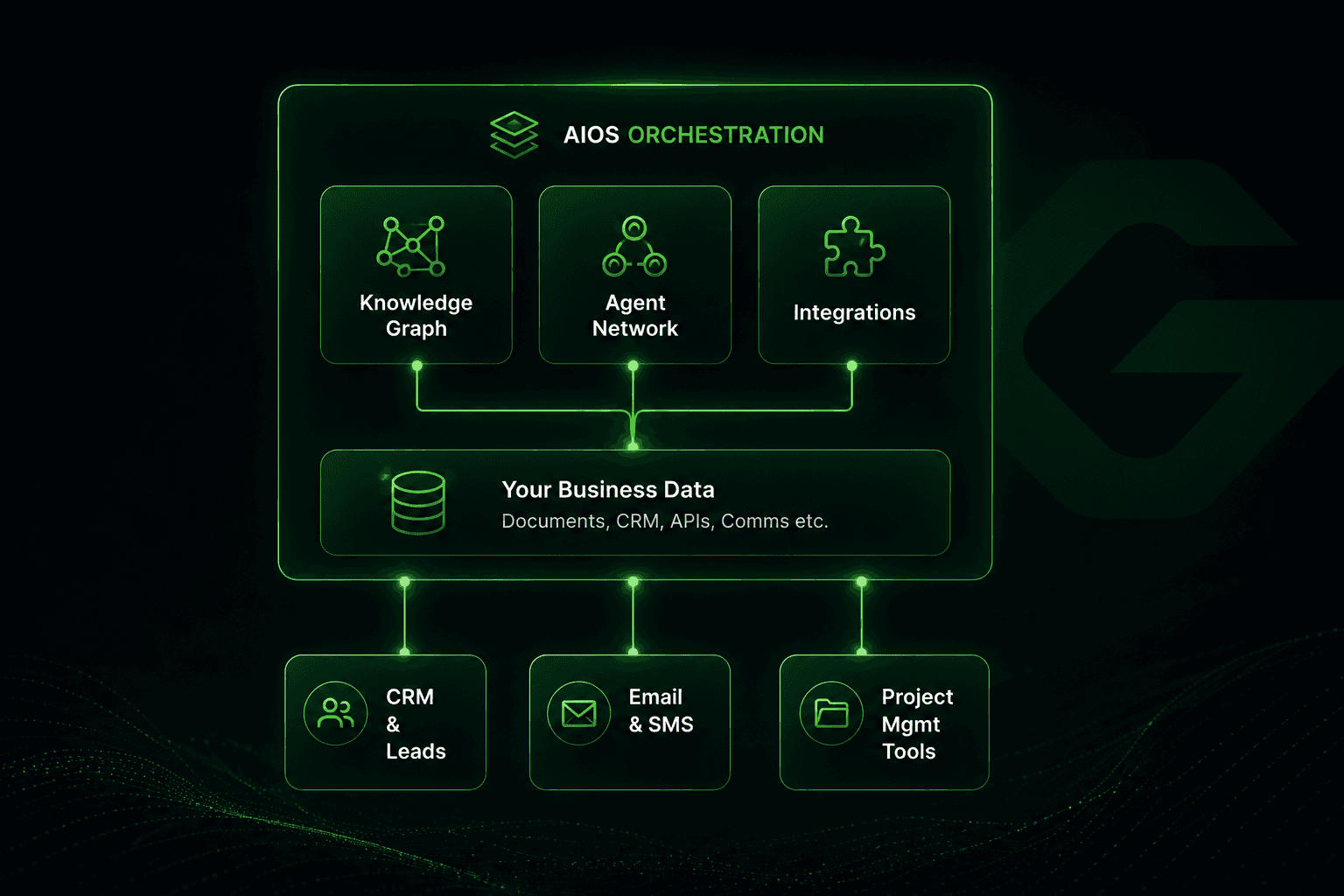
At a glance: an orchestration layer sits at the top, calling on a knowledge graph, an agent network and an integration layer that all read and write from your underlying business data, CRM, email and project tools.
How Your AIOS Connects to the Tools You Already Use
An AIOS isn’t a rip-and-replace exercise. It’s designed around what you already have. Here’s how the pieces map to the solutions you’ve probably heard of in the context of an AI agent operating system.
- AI CRM and lead operations: your AIOS becomes the central hub for all your lead data, tracking conversations, qualifying prospects and triggering the right follow-up at the right time.
- GEO / AI Search Visibility: the knowledge graph surfaces everything your business knows about specific topics, powering the content and authority that makes you visible in AI-powered search.
- PPC Intelligence and Reporting: your AIOS monitors campaign performance, identifies optimisation opportunities and surfaces insights humans would miss in the noise.
- AI chatbots and inbound automation: every customer interaction feeds into the shared knowledge base, so the AI gets better at answering questions with each conversation.
- AI marketing automation: from content creation to campaign optimisation, the AIOS ensures every output is informed by your actual business data and strategy.
- AIOS design and integration: the process of architecting and connecting the whole system to your specific stack, your specific workflows, your specific business.
When these pieces are connected, you don’t get seven tools. You get one system.
Who Needs an AIOS Right Now
You should be thinking about this if:
- you’re using multiple AI tools but they don’t share context
- lead enquiries are falling through because your processes aren’t connected
- you want AI agents doing real operational work, not just generating text
- your team spends more time briefing people on context than getting work done
- you have valuable data trapped in systems that AI can’t access
- you’re growing and already feeling the knowledge gaps between departments
If you’re still experimenting with AI for fun, an AIOS is overkill. But if AI is starting to matter to your actual operations and the friction is building, an AIOS is your next move.
How Long Does It Take to Build?
A properly designed AIOS isn’t a weekend project. But it’s not a 12-month enterprise transformation either; it’s a modular approach to integrating AI.
For most SMBs we work with:
- Weeks 1–2: discovery and design. We map your data, your workflows, your tools and where the gaps are costing you money.
- Weeks 3–4: build and integrate. The core AIOS goes live, including the knowledge graph, orchestration and initial integrations.
- Weeks 5–6: refine and expand. Agents get trained on your actual data, integrations get tested, edge cases get handled.
- Ongoing: it compounds. The system gets smarter with every interaction. You add capabilities as your business scales.
The key is starting with a clear use case. You don’t need the full system on day one. But you do need the architecture designed right from the start, so everything you add later plugs in cleanly.
Where This Is Going
The companies that win the next three years won’t be the ones with the best AI tools. They’ll be the ones with the best AI infrastructure.
Because here’s the reality: AI tools will keep getting cheaper, faster and more capable. That’s not a moat. Anyone can buy GPT-5 when it ships. The moat is how intelligently you’ve wired AI into your actual operations: your data, your customers, your workflows, your decision-making.
An AIOS is how you build that moat.
Ready to Build Yours?
Ready to stop piecing together disconnected AI tools and start building a system that actually works for your business?
Book a free AI consultation with the Generativ team and we’ll map out what an AIOS could look like for your specific stack, workflows and growth goals. No pitch. Just clarity on what’s possible and what it would take to get there.
Generativ designs and deploys AI Operating Systems for businesses that want their intelligence to compound, not fragment. Based in Nottingham, working across the UK.